
Hair or Fur?
The Science of the Strand
Welcome to the first installment of our new mini‑series: The Zoomies Guide to Dog Coats. Over the next few weeks, we’re pulling back the curtain on the anatomy of canine coats so you can finally understand what’s actually going on with your dog’s hair (or fur), how to care for it at home, and why some breeds spend more time on the grooming table than others.
By the end of this series, you’ll know your dog’s ideal grooming schedule - both professional appointments and the at‑home maintenance that keeps their skin and coat healthy between visits.
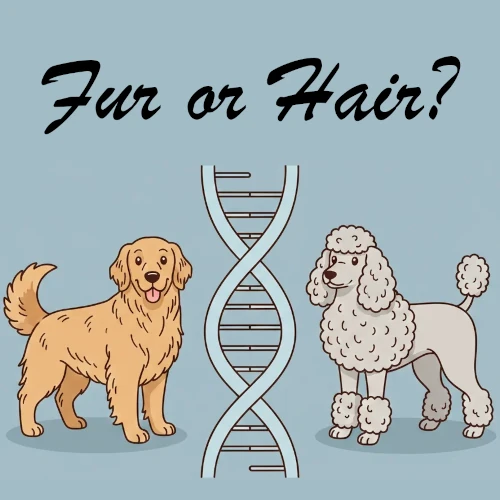
Before we can identify your dog’s specific coat category, we have to start with the foundation: Is it hair or fur?
The Biological Breakdown
Scientifically, hair and fur are made of the same protein - keratin. The difference isn’t in the material, but in how each strand grows, sheds, and behaves. Understanding these differences is the key to understanding your dog’s grooming needs.
Dog Fur
Fur grows to a predetermined length and then stops. It has a short, fast growth cycle, which means it reaches maturity quickly, dies, and sheds - often in impressive quantities. Fur is usually thicker and coarser than hair and is commonly paired with a dense undercoat that helps regulate body temperature.
- Labrador Retrievers, German Shepherds, Alaskan Malamutes
- Huskies, Australian Shepherds, Border Collies
- Pomeranians, Shiba Inus, Corgis
These dogs shed seasonally and continuously, and their undercoat can become impacted if not brushed out regularly.
Dog Hair
Hair‑coated dogs typically have a single layer (no undercoat) and a long, slow growth cycle. Because the hair keeps growing and doesn’t fall out as frequently, these dogs are often labeled “hypoallergenic” - not because they produce fewer allergens, but because they shed less dander into the environment.
Hair is usually finer and smoother than fur and can be curly, wavy, or straight. Like human hair, it will continue growing until it’s cut.
- Standard Poodles, Irish Water Spaniels, Afghan Hounds
- Portuguese Water Dogs, Soft-Coated Wheaten Terriers, Lagotto Romagnolos
- Shih Tzus, Yorkies, Maltese, Havanese
These dogs require routine trimming and consistent brushing to prevent tangles.
Why Does This Matter to You?
Knowing whether your dog has hair or fur determines what kind of maintenance you’ll be doing at home - and how often your dog should see a professional groomer.
The Fur Focus: Deshedding
If your dog has fur, your main job is managing dead undercoat. Because fur sheds constantly, loose hair can get trapped against the skin, leading to packing, which can cause irritation, hot spots, and even skin infections.
Your at-home priorities:
- Regular brushing with tools designed for undercoat removal
- Monitoring for impacted areas behind the ears, under the collar, and along the thighs
- Seasonal brushing “boosts” during spring and fall
Professional grooming benefits:
- Deep deshedding treatments
- Forced‑air drying to lift and remove impacted undercoat
- Coat‑safe shampoos that reduce shedding and support skin health
These dogs don’t typically need haircuts, but they absolutely benefit from routine deshedding services.
The Hair Focus: Dematting
If your dog has hair, your main job is tangle prevention. Because the hair doesn’t fall out, it wraps around itself and forms mats - sometimes surprisingly quickly.
Your at-home priorities:
- Daily brushing (yes, daily)
- Using the right tools for your dog’s coat texture - slickers, combs, or pin brushes
- Checking friction zones: armpits, behind the ears, tail base, collar line
Professional grooming benefits:
- Regular haircuts every 4-8 weeks
- Coat-specific shampoos and conditioners to reduce tangling
- Skilled scissoring and clipper work to maintain a manageable length
Skipping maintenance on a hair‑coated dog almost always leads to matting, which can be painful and may require a shave‑down for the dog’s comfort.
What's Next?
Now that you understand the difference between hair and fur, you’re ready to figure out where your dog fits in the bigger picture.
Stay tuned for Part Two: Coat Identification – Finding Your Dog’s Category, where we’ll break down smooth, wire, curly, double, and combination coats so you can confidently identify your dog’s unique needs.