
The Leash Telegraph
How Your Energy Changes Your Dog's Behavior
The Invisible Connection
Have you ever noticed how your dog seems to know exactly when you're about to turn a corner or cross a street? How he suddenly perks up the moment you spot a squirrel three blocks away? It isn't just his incredible sense of smell or sight at work; it's a classic example of the leash telegraph. Think of the leash as a high-speed fiber optic cable. Every bit of data about your emotional state - your stress, excitement or hesitation - travels down that line and reaches your dog almost instantly.
We often focus so much on vocal commands, like Heel or Leave It, we completely forget the silent signals. Before a single word leaves your mouth, your body has likely already sent a message. If your grip tightens or your shoulders hunch, you've essentially just sent a Breaking News alert directly to your dog's neck. He is going to react to that information long before he listens to your verbal cues.
The Tight Leash Trap
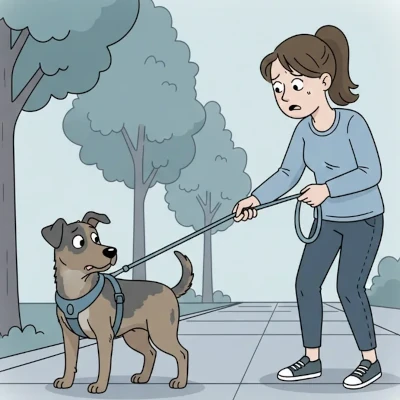
The most common mistake pet parents make is falling into the tight leash trap. It's a classic catch-22 - you tighten the leash, you just want to keep your pup under control. However, the act of tightening it actually makes him harder to manage. This physical tension turns a casual stroll into a high-stakes mission where both ends of the leash are on edge.
Feedback Loop
We've all been there - you're walking down a quiet street in Potomac and spot a squirrel or a "rival" dog three houses away. Your hand instinctively cinches up the slack. This is the start of a negative feedback loop. By shortening the leash and tensing your muscles, you are broadcasting a Danger! signal. Your dog feels that sudden pull and immediately tenses too. His adrenaline spikes - if you are worried, he assumes he should be worried too! His posture shifts and suddenly he is scanning the environment for whatever caused your sudden change in energy.
Creating Reactivity
Over time, this constant tension can actually create or worsen leash reactivity. When a dog is held on a tight, restrictive leash, he loses his ability to communicate through natural body language. He can't turn his body away or move in a relaxed arc; he can't self-soothe with a calming sniff. Feeling physically trapped, while also sensing your anxiety through the leash, can force a dog into a fight or flight response. What looks like aggression - lunging or barking - is often just a dog who feels restricted and is reacting to the stress he feels vibrating down the line from your hand.
Mastering the J Shape
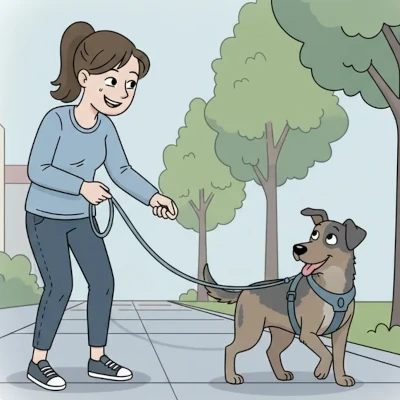
One of the first things we look for at Zoomies is the geometry of the leash. If you want to change your dog's behavior, you have to change the shape of the line connecting you. The gold standard for a stress-free walk is what we call the J shape - the visible, relaxed curve that forms when the leash is hanging loosely between your hand and your dog's harness.
The Goal
The ultimate goal of every walk is to maintain that slack curve, even when there are distractions nearby. This loose loop serves as a physical manifestation of trust. When the leash is slack, you are signaling to your dog that the environment is safe and that you are not worried. To a dog, a loose lead means he has the freedom to sniff and move naturally, which significantly lowers his heart rate. It communicates a powerful message: "I'm in control and everything is fine." By keeping the loose leash, you break the telegraph of tension and allow your dog to mirror your calm, grounded energy.
Breathing Through the Stress
It sounds incredible, but your dog is a furry biofeedback machine. Because they have evolved to live alongside us for thousands of years, they are masters at reading our physiological state. They are sensitive enough to hear the slight increase in our heart rate and feel the change in our breathing patterns. If you hold your breath because you're anticipating a lunging moment around the next corner in King Farm, your dog picks up on that stillness as a sign of imminent conflict. Whatever happens next will remain encoded in his brain as a bad interaction.
Zoomies Tip: The Big Exhale
One of our favorite tricks for breaking a tense moment is what we call the Big Exhale. If you feel yourself tensing up, or if your dog is starting to fixate on a squirrel, take a deep breath and let out a very audible, dramatic sigh. This physical exhale does two things: it forces your own muscles to relax and it sends a clear social signal to your dog that the threat is over. It's a literal reset button for the energy on both ends of the leash. You'll be amazed at how often your dog will look back at you and shake his fur out in response to your big exhale - he is literally shaking off the stress you just released.
Grounded Leadership
At Zoomies, we strive to be the calm center of every walk. Being a leader doesn't mean being loud or forceful; it means being grounded. When we walk through Montgomery County, our goal is to remain the most stable element in the dog's environment. If a car backfires or a neighbor's dog starts barking at the fence, we don't react with a jerk of the leash or a sharp shout. We remain neutral.
We practice this neutral energy specifically to help nervous or over-excited dogs find their focus. By maintaining a relaxed posture and a steady pace, we provide a safety anchor for the pup. When the human remains unbothered, the dog eventually realizes they don't need to be on high alert either. This grounded leadership is how we turn a chaotic walk into a peaceful stroll, one "J-loop" and one big exhale at a time.