Our Honest Take on Harnesses vs Collars; How to Choose the Right Equipment for your Dog
The Myth of the Magic Tool
We have all been there: you step out the front door, leash in hand, dreaming of a picturesque stroll through the neighborhood, only to find yourself being dragged down the sidewalk like the anchor of a runaway freight train. The “sled-dog walk” is one of the most common frustrations we hear about from pet parents in Montgomery County. It’s exhausting, it’s hard on your shoulders, and it often turns a bonding activity into a stressful battle of wills. It is only natural to go searching for that one “magic” harness or collar that will instantly transform your pup into a champion heeler.
Reality Check: Training is the Ultimate Tool
Here is the professional truth: every trainer worth their salt will tell you that there is no piece of equipment that “fixes” pulling—only consistent training can do that. Proper loose-leash walking is a skill that must be taught and reinforced. However, at Zoomies, we also live in the real world. We understand that training takes time, patience, and repetition, which can be a massive challenge when you still need to exercise your dog every single day. The right gear isn’t a substitute for training, but it is a vital bridge. It sets the stage for success by giving you better control and ensuring your pet stays safe and comfortable during every stage of their learning journey.
Collars: Standard vs Specialized
At Zoomies, we generally lean toward harnesses for the bulk of our walking adventures because of the safety and control they provide. However, every dog is an individual, and there are certainly cases where a collar is the more appropriate choice for the walk itself. Regardless of what is attached to the leash, we believe that every dog should wear a flat or martingale collar at all times to carry their essential ID and Rabies tags.
Flat Collars
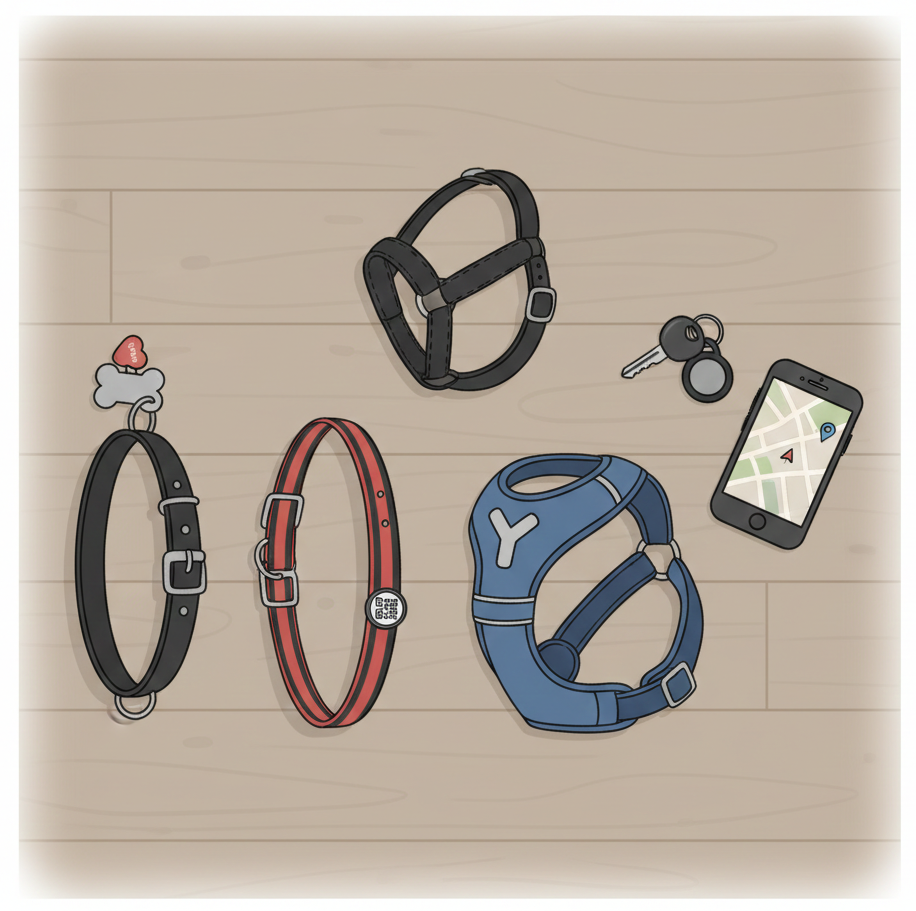
The traditional flat collar is the most common piece of equipment you’ll see at the park. These are perfectly effective for the “pro-level” walkers—those pups who naturally keep a loose lead and stay right by your side. Because a flat collar offers very little in the way of leverage or redirection, we typically reserve them for well-behaved walkers or for specific physiological exceptions where a harness might do more harm than good.
Martingale Collars
Originally designed for dogs with heads narrower than their necks, the martingale (or “limited-slip”) collar is a fantastic safety alternative. It consists of a main loop and a smaller control loop where the leash attaches. When the dog pulls, the collar cinches just enough to prevent them from backing out, without the choking effect of a traditional slip chain. In the later stages of training, a martingale can serve as a gentle “reminder” for a pup who starts to drift or tug, offering a subtle tactile cue to refocus.
Notable Exceptions
While we love a good harness, there are several scenarios where a collar is actually the safer or more comfortable choice for the dog’s specific needs.
Flight Risk Anatomy
For sighthounds like Greyhounds or Whippets, or any “cone-headed” breed where the neck is wider than the head, a harness can sometimes be a liability. These “Houdini” dogs can often back out of a standard harness with a well-timed wiggle. For these pups, a martingale collar is essential; the gentle cinch ensures the collar stays behind the ears, preventing a scary escape during a walk.
Brachycephalic Overheating
Our flat-faced friends—like Frenchies, Pugs, and English Bulldogs—have delicate airways that must be protected, which usually makes a harness the first choice. However, Montgomery County summers are notoriously brutal. Because harnesses cover a larger surface area of the dog’s torso, they can trap heat and contribute to overheating. In the height of July, we may recommend a flat collar for short potty breaks if the dog is well-trained and won’t struggle, allowing their body to stay as cool as possible.
Skin Sensitivity & Friction
Hairless breeds or those with very thin, smooth coats can be prone to “harness sores,” rashes, and painful chafing at the contact points under the armpits. In these cases, a padded flat collar or a silk-lined martingale is much kinder to their skin. This is also one of the rare exceptions where we might suggest removing the “24-hour ID collar” while indoors, as even the most comfortable tags can cause irritation on highly sensitive skin.
Orthopedic & Mobility
If a dog is nursing a shoulder injury or living with a front-end disability, the pressure of a harness can be painful or even alter their natural gait. Moving the control point to a flat or martingale collar shifts that pressure away from the site of pain, allowing them to move more freely and comfortably while they heal or manage their condition.
Long-Haired Mat-Prone Breeds
For Poodles, Doodles, Goldens, and Afghan Hounds, friction is the enemy of a beautiful coat. Harness straps—especially in the armpits and across the chest—can cause mats to form almost instantly. For these “Groomer’s Delights,” we often suggest a rolled leather collar designed to prevent matting, or a martingale collar that sits loosely on the neck until tension is applied.
The Zoomies Rule
While we utilize a variety of tools to keep our pack safe, we have one firm boundary: The Zoomies Rule. We strictly avoid “correction” collars, such as prong or choke chains. Our philosophy is built on positive communication and building a bond of trust with your dog. We believe that we can achieve better, more lasting results through redirection and rewarding good choices rather than utilizing tools designed to cause discomfort. Safe walking should be a conversation, not a correction.
The Harness Deep-Dive
For the vast majority of our pack, a harness is the daily driver. Outside of the specific medical or anatomical exceptions we mentioned, a harness provides a significantly higher level of safety and control. It removes the risk of neck injury and gives us a much sturdier “handle” on the dog’s center of gravity. However, where you clip that leash makes a world of difference in the feedback your dog receives.
Front Clip (No-Pull)
The front-clip harness is the most popular tool for managing pullers. By placing the attachment point at the center of the chest, the harness uses basic physics to your advantage. When a dog tries to lunge or pull forward, the tension on the leash naturally redirects their body back toward you. It’s not painful; it simply makes it physically difficult for them to gain the forward momentum they want. It’s like having power steering for a dog that wants to be a freight train.
Back Clip (Musher’s Lead)
A back-clip harness is what most people think of when they imagine a dog in a harness. While comfortable, these can actually trigger what we call the “opposition reflex.” This is the same instinct that allows sled dogs to pull thousands of pounds—when they feel pressure on their chest and shoulders from a back-clip, their natural response is to lean into it and pull harder.
However, there are times when the back-clip is the right choice for gait correction. For example, our own 2-year-old Shiba Inu recently started “crabbing”—altering her stride to run diagonally because she was anticipating the redirection of the front-clip. To fix this, we had to go back to basics with her training and switch her to a back-clip to ensure she was moving straight and using her body symmetrically.
Gentle-Lead (Face Harness)
The Gentle-Lead (or head halter) is a specialized tool we use for very powerful pullers or dogs that are highly reactive to their environment. It works on the same principle as a halter for a horse: where the nose goes, the body follows. It allows a walker to redirect a dog’s gaze with very minimal physical effort, making it a vital safety tool for smaller walkers with very large, exuberant dogs.
You may have seen “Gentle-Lead” branded body harnesses, but at Zoomies, we stick strictly to the face harness version of this brand. We find that the face harness offers a unique level of communication and “power steering” that their body harness doesn’t quite match, especially when we need to break a dog’s hyper-focus on a squirrel or another pup across the street.
The Always-On Identification Strategy
The “Always On” Identification Strategy
While we are big proponents of the harness for its safety during walks, we have a very strict rule in the Zoomies household: your dog should always be wearing a collar with their ID and Rabies tags. We like to think of these as their “necklaces.” In fact, our own dogs seem to understand that their necklaces mean they belong to us. They get a little worried when we take them off to wash the collars or give them a deep neck scratch, and they dance eagerly the moment they hear the jingle of the tags coming back toward them.
The practical reason for this is simple: if your dog accidentally slips out of the front door or manages to find a loose board in the fence, they won’t necessarily be “dressed” for a walk in their harness. Having a permanent collar ensures they always have visual identification. It is the fastest way for a neighbor to help them get back to you before they even leave your street.
Smart / QR Tags
In 2026, we have some incredible tech options that go far beyond a simple engraved phone number. QR Tags are a favorite for the “Groomer’s Delight” pack or dogs with medical needs. When someone scans the code with their smartphone, it opens a digital profile where you can list emergency contacts, allergies, and even your vet’s info.
Another amazing innovation is the Ring Pet Tag. This integrates directly with the Ring Neighbors network. If your dog goes missing, you can launch a “Search Party” in the app, which alerts nearby neighbors to keep an eye out. Some Ring cameras can even use AI to recognize a “lost dog” profile and send you a notification if your pup wanders into a neighbor’s yard!
GPS Trackers
For the ultimate peace of mind—especially for our adventurous friends who might wander further afield—GPS tags are the gold standard. For iPhone users, Apple AirTags are a fantastic, cost-effective backup that utilizes the massive network of Apple devices in Montgomery County to ping a location. If you are looking for true real-time tracking, we’ve seen great results with brands like Tractive or PitPat. These give you a live map of where your dog is at any given moment, which is a game-changer if you have a local escape artist who likes to test the boundaries of your Rockville backyard. These devices attach right to the “necklace” and provide that extra layer of security that a standard tag just can’t match.
Choosing for Your Dog
At the end of the day, the “Zoomies-Approved” setup is the one that makes both you and your dog feel confident and safe. No one knows your pup’s quirks, strengths, and fears better than you do. When assessing your gear, start by looking at their physical build and their typical behavior on a walk—are they a “freight train” puller, a sensitive soul with delicate skin, or a Houdini who can wiggle out of anything? Trust your judgment and don’t be afraid to experiment with different combinations until you find that perfect balance of comfort and control. If you’re feeling overwhelmed by the options or just want a second pair of professional eyes, feel free to drop a comment below! We’re always happy to help our Montgomery County neighbors find the right fit for their pack.