The Safety of the Team Approach for Multi-Dog Homes
The Multi-Dog Dynamic
When you have more than one dog in a social setting, there are always risks. Even with dogs from the same household! Siblings have some similarities that remain no matter what species! First, they often have differing needs and personalities. More importantly: siblings bicker. For some dogs, that can be as mild as competing for attention from the walker. However, even dog siblings who have always gotten along at home can shift under the care of someone else. Under new and stressful conditions, even best buddies can escalate to deferred aggression. This is where the more worked up dog will turn on his sibling, picking a real fight because he can’t handle the stress trigger.
More Dogs Means More Complexity
When you have a household with multiple dogs, the joy is doubled and so is the complexity of their care. At Zoomies, we’ve learned that walking a “pack” is never as simple as just grabbing a handful of leashes and heading out the door. Just like human siblings, being part of the same family doesn’t mean they have identical needs, temperaments, or triggers. What keeps one dog calm might overstimulate another, so trying to address those individual needs simultaneously requires more than just strength. It requires a specialized strategy.
Gaps & Differences
Physical and mental challenges arise the moment you have gaps in age, size, or energy levels. Take our new pack members, Cookie and Tribble, for example. Cookie is a 13-year-old distinguished gentleman who really just wants a quick, efficient potty break in the yard; he doesn’t need or want a long-distance adventure. On the other hand, his 4-year-old sibling, Tribble, is a ball of energy who craves a high-intensity neighborhood exploration.
A single walker is forced to compromise: they might take Cookie to potty and then spend the remaining 20 minutes focusing on Tribble while Cookie waits. However, with the Zoomies Power Team approach, two walkers can take them out together. This allows one walker to turn back with Cookie the moment he’s finished his business, giving him one-on-one attention and comfort back inside the home. Meanwhile the second walker continues for a full, uninterrupted thirty-minute adventure with Tribble. By acknowledging these differences, we ensure neither sibling has to sacrifice their “best life” for the other.
Why We Don’t “Solo-Squad”
Defining the Solo-Squad Risk
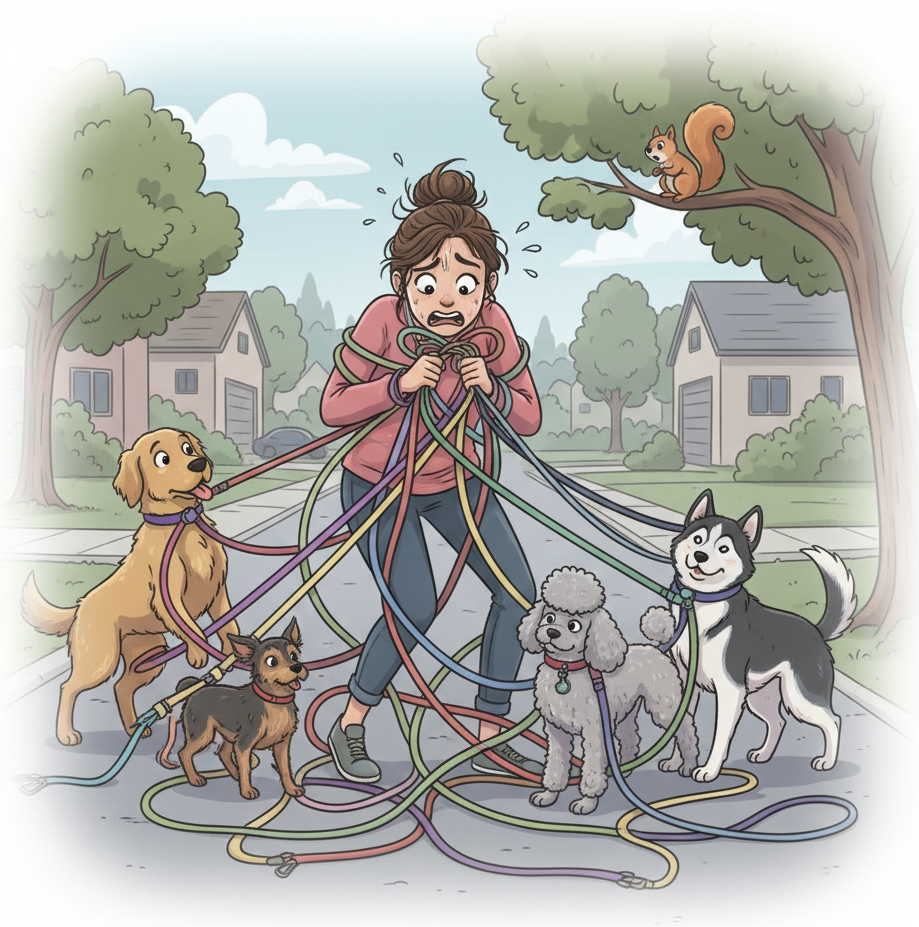
In the pet care industry, it’s common to see a “Solo-Squad”—one walker attempting to manage three, four, or even five dogs at a single time. While it might look impressive, at Zoomies, we view this as a significant safety risk. When one person is responsible for a group of dogs, their physical and mental bandwidth is stretched to the limit, leaving very little room for error.
The Mechanical Danger of Tangled Leads
The most immediate mechanical danger is the loss of the “J-curve.” With multiple leads in one hand, it is nearly impossible to maintain that relaxed, loose-leash communication. Leads inevitably become tangled, creating a web of tension that sends confusing signals through the “Leash Telegraph.” More importantly, if gear fails, a solo walker simply doesn’t have enough hands to handle the crisis.
We had a perfect example of this during a walk and play session last week. Spray was handling our big dog, Oakley, acting as our “scout,” while I was handling our little dog, Luna, and the client’s dog. Suddenly, the client’s retractable leash broke—the release button popped. As I instinctively scrambled to rearrange the broken leash and keep the client dog secure, I realized I no longer had Luna’s leash in my grip; it was just hanging loosely over the client’s lead. Because Spray was right there, he noticed before I’d even made a sound. He immediately took the client’s leash from me, which allowed me to grab Luna’s leash and freed me up to give chase if anyone had bolted. If I had been a “Solo-Squad” that day, one broken piece of plastic could have resulted in a dog loose on the street.
The Environmental Factor
This story highlights why split focus is so dangerous. Montgomery County is full of “surprises”—a deer darting across the road, a car turning a corner too fast, or an off-leash dog approaching unexpectedly. When one walker is managing a pack, they are often forced to be reactive, focusing on the tangled mess of leashes at their hip. With our team approach, we ensure that while one person is focused on the pups, the other is scanning the environment. This proactive scouting allows us to spot triggers before they enter the dogs’ “alert zone,” ensuring we stay in control of the energy and the safety of the walk.
The Zoomies Power Team Advantage
The Two-Walker Standard
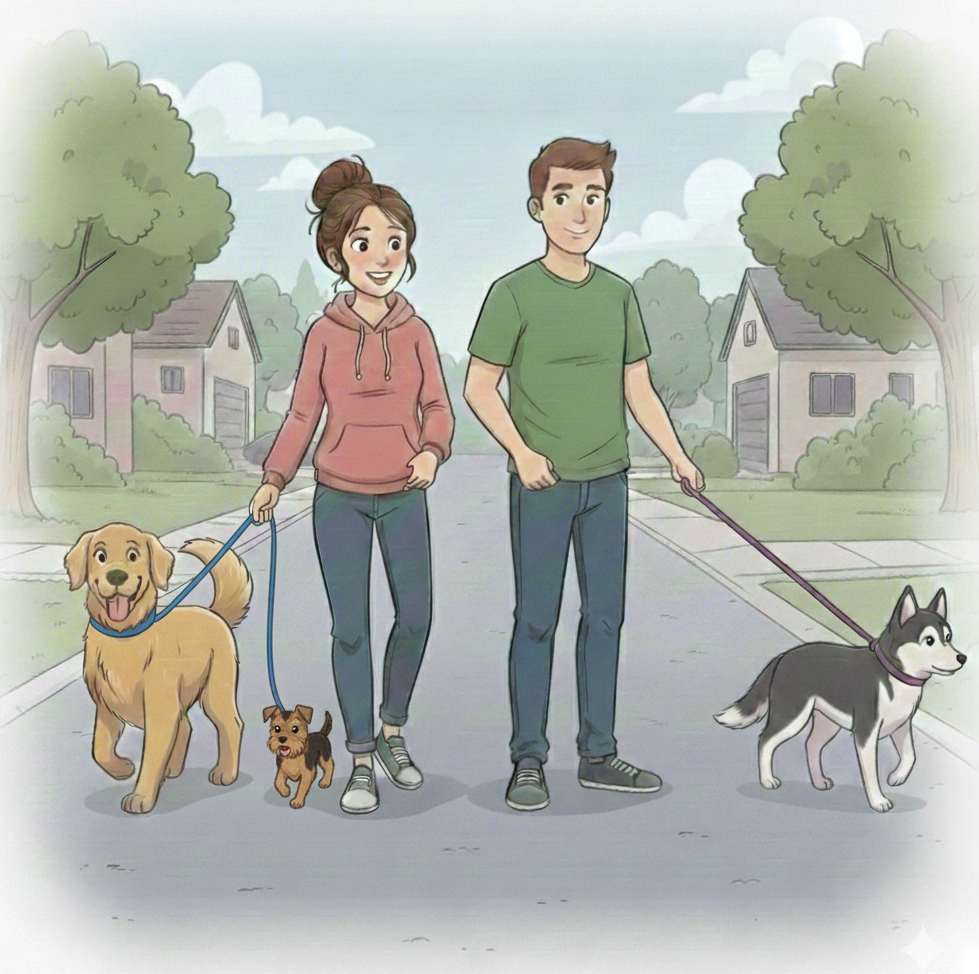
At Zoomies, we believe that more dogs shouldn’t mean less safety. That is why we implemented our “Power Team” approach for any household with three or more dogs. Instead of one person struggling to juggle a handful of leashes, we bring in a second set of hands—typically myself and my partner, Spray. This isn’t just about physical strength; it’s about maintaining the high standard of care that Zoomies is known for. By having two walkers, we ensure that the “pack” is always manageable and that we are never more than an arm’s reach away from total control.
The “Divided but Equal Attention” Benefit
The biggest winner in the Power Team model is the dog. Our approach provides a “divided but equal” benefit, ensuring that every pup gets a 1:1 connection even during a group outing. In a solo-walked pack, dogs often have to compete for the walker’s attention or pace. With two of us, we can give each dog the individual focus they deserve, checking in on their body language and making sure they are actually enjoying their time outside.
This also allows us to match specific walker energy to specific dog needs. On a walk, personalities often split: you might have one dog who is a “sniffer” and wants to investigate every blade of grass, while their sibling is a “bolter” who wants to maintain a brisk, athletic pace. With the Power Team, we don’t have to frustrate the bolter or rush the sniffer. One walker can slow down to let the explorer enjoy their “scent-work,” while the other maintains a steady stride with the high-energy pup. Everyone gets the walk they actually want, rather than the one they are forced to share.
Safety in Numbers
Emergency Preparedness
In the pet care world, we plan for the “what ifs.” What happens if a dog steps on a piece of glass, experiences a sudden medical flare-up, or a piece of gear—like a harness buckle or a leash clip—fails entirely? In a solo-walking scenario, an emergency with one dog creates an immediate safety crisis for the others. You cannot easily carry an injured dog or fix a broken harness while simultaneously managing two other leashed pups.
Having a “free set of hands” means we can manage an emergency without compromising the rest of the pack. As we saw with the retractable leash incident, having that second person allows for an immediate transfer of responsibility. One person can focus entirely on the dog in need—whether that’s providing first aid or securing a broken lead—while the other maintains a “safety perimeter” with the other dogs. It ensures that one dog’s bad luck doesn’t turn into a dangerous situation for the whole family.
Proactive Scouting
The best way to handle a crisis is to prevent it from happening in the first place. This is where “Proactive Scouting” comes in. Every dog has an “alert zone”—that specific distance at which they spot a trigger (like a stray cat or a noisy delivery truck) and begin to react.
With two sets of eyes, we can double our scanning radius. One walker focuses on the immediate behavior, the other acts as the navigator, scanning the environment half a block ahead. This allows us to spot potential triggers before they ever enter the dogs’ alert zone. We can cross the street or turn a corner long before the dogs even realize there was something to bark at. It keeps the energy low and the safety high, every single step of the way.
“Pack Walk” Without the Stress
Pack Walk Without the Stress
The beauty of the Power Team approach? It allows for a true “pack walk” experience without any of the associated chaos. When siblings walk together with separate handlers, the dynamic shifts from a tangled scramble to a smooth, controlled exercise session. The dogs still get the psychological benefit of traveling together as a family unit, but they aren’t physically competing for space or inadvertently jerking each other’s collars every time someone stops to sniff.
This structure is the only way to effectively maintain individual leash manners in a multi-dog home. Because each dog has their own dedicated handler, we can still practice the leash manners for every pup individually. It ensures that even in a group setting, your dogs are learning to focus on their walker and maintain their grounding, rather than feeding off the excitement or anxiety of their siblings. We get to preserve the integrity of the walk for everyone involved. And we make sure that when we return them to your home in Montgomery County, they are tired, happy, and—most importantly—calm.